I am drawn to the promise of AI, but the part that stayed with me was almost the opposite: a powerful technology can be real and still fail to change my life, my work, or the economy right away. The distance between invention and lived reality can be several years—or several decades.
This note began with a two-part explanation by Wall Street Ajusshi's Scientific Investing. In the writing process, the two YouTube links were distilled with Lilys AI into timestamped summaries, and its source chat was used to question the argument and narrow the outline. That summary was a map rather than a substitute for the originals: the figures and assumptions were checked again against the videos and papers (part 1, part 2, Lilys AI feature page).
The first video starts from an extraordinary historical break. U.S. living standards have grown at roughly 2 percent per year for about 150 years, while per-person income moved only slowly over the much longer preindustrial past. In the video's rough comparison, two millennia produced only about a doubling, while the recent 150 years produced more than a twentyfold increase (part 1).
The proposed engine is not simply more capital or more hours of work, but total factor productivity—the ability to produce more with the same measured inputs. The video explains this through ideas. An idea is non-rival: once crop rotation, a formula, or a production method exists, many people can use it at the same time without consuming it. That property lets growth repeatedly push past ordinary diminishing returns (part 1).
Yet producing ideas still uses rival and limited inputs: researchers, time, laboratories, organizations, and judgment. Bloom, Jones, Van Reenen, and Webb estimate that measured semiconductor research productivity declined by around 7 percent per year and that aggregate U.S. research productivity fell by a factor of 41 from the 1930s. Their result is not “there are no ideas left,” but that sustaining exponential progress has required rapidly rising research effort (Are Ideas Getting Harder to Find?).
This makes AI look like the missing fuel. If machines can search literature, write software, design experiments, prove results, and improve the tools used to make the next idea, the bottleneck in idea production could loosen. The attractive story is a flywheel: better AI creates better ideas, including better AI, and growth accelerates.
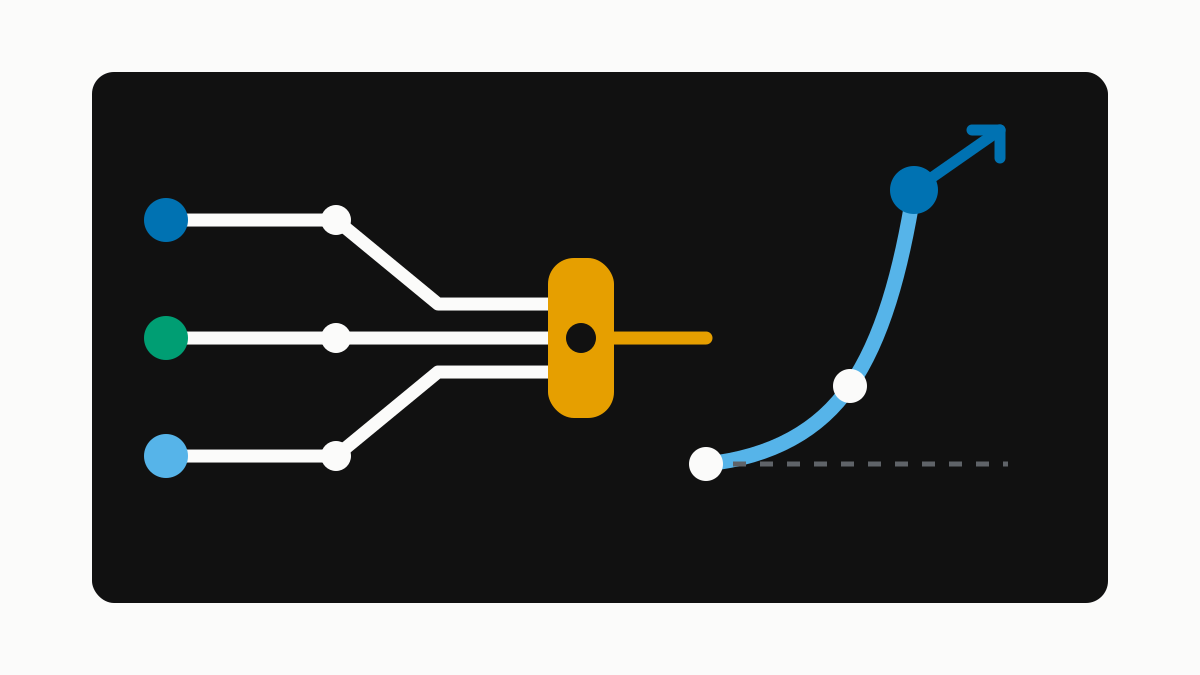
Jones and Tonetti add a difficult condition to that story: the economy is made of complementary tasks. If an automated task becomes nearly free while a necessary human task remains slow, total output is still constrained by the human task. In their “weak link” model, the whole system behaves less like a pile of interchangeable inputs and more like a chain whose strength is set by its weakest link (Jones and Tonetti, part 2).
The small early numbers follow from that model, not from a claim that AI is weak. Under the paper's strong-complementarity calibration, making the tasks performed by today's software infinitely productive raises aggregate output by only about 0.5 percent. Infinitely automating tasks equal to half of GDP raises output by about 19 percent. Doubling income per person requires automating tasks that initially account for roughly 94 percent of GDP. These are conditional model calculations, not point forecasts (Jones and Tonetti, part 2).
A familiar software example makes the mechanism concrete. AI may write all the code for a feature, but the feature still needs the right problem, access to data, a decision about risk, a customer willing to change a habit, a legal path, insurance, deployment, maintenance, and someone accountable when it fails. Cheap code makes the remaining links more visible. It does not automatically remove them.
The second video interprets the model's baseline as a long runway: growth acceleration may remain muted for roughly 75 years and become explosive only as nearly all weak links disappear. The exact timing is highly sensitive to assumptions. The sturdier historical point is that electricity, semiconductors, computers, and information technology took decades to diffuse because factories, organizations, skills, and complementary systems also had to be redesigned (part 2, Jones and Tonetti).
This is the part I found most moving. We often imagine the future as a product launch: the model arrives, and the world changes. History looks more like slow connection work. Power grids, standards, institutions, interfaces, laws, trust, and habits have to meet the invention. For a long time the pieces look disappointing and disconnected. Then enough of them fit, the last bottlenecks loosen, and growth that seemed absent can arrive all at once.
I would watch three signals before believing the takeoff has reached the whole economy:
- Productivity and total factor productivity leaving their old trend, not just benchmark scores rising.
- Prices collapsing in tasks AI performs well while prices and wages rise around scarce human bottlenecks.
- Complementary systems—energy, robots, regulation, insurance, organizational design, and accountability—changing together rather than one demo improving alone.
The investment implication is less “buy the smartest model” and more “find the stubborn link that everyone else must pass through.” But a bottleneck is not automatically a good investment; regulation, bargaining power, competition, and valuation determine who captures the value. In the short run, AI capital expenditure can also add demand and inflation pressure before productivity lowers costs. This is a framework for observation, not investment advice.
Work may follow the same pattern. Individual tasks can be automated quickly while whole jobs and institutions change slowly. People who define the problem, connect systems, make trade-offs, and accept responsibility may become more valuable precisely because generated output becomes abundant. The scarce work moves up one layer.
So I hold two ideas together. AI can be the largest engine of idea production we have built. And it may take far longer than the product cycle for that engine to change the texture of an ordinary day. Patience here is not pessimism. It is attention to the links between invention and life. When those links finally align, the change may be larger—not smaller—than today's hype can describe.
Sources checked on 2026-07-29. The Jones–Tonetti paper is a May 2026 working-paper version, and its parameters, estimates, and timetable may change in later revisions.