The moment we wake up, our phones give us a sleep score. We answer messages and email, check investment returns in a banking app, choose a delivery window, and deal with insurance and subscription renewal alerts. We match our exercise targets, share family calendars, and compare flights, hotels, and routes for a trip. Each task is easier than it used to be. Put together, however, one person has become the finance team, health team, security team, purchasing team, travel agency, and customer service desk for their own life.
Technology has removed many inconveniences. We can transfer money without waiting in line, shop from home, find our way in unfamiliar places, and contact people far away instantly. The problem is that the space left by those inconveniences did not remain empty. Dozens of choices, checks, and updates made possible by new services returned to daily life as small management jobs.
Each action takes less effort, but the total number of actions has grown even faster. When one person can handle more work, a company is more likely to expect broader responsibilities and greater speed than to let that person work less. Individuals also tend to spend saved time searching for better investments, better health, a more efficient schedule, and a more perfect choice. Technology saves time, but organizations, markets, and even we ourselves often see that time not as rest but as unused productive capacity.
Living Like a One-Person Company
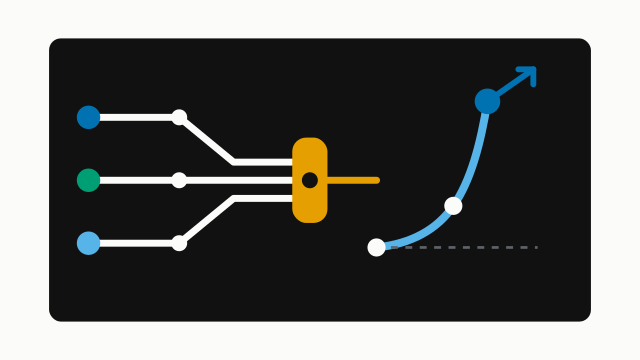
In the past, many people received a salary, spent it, and saved what was left. Now we compare pension-account returns, choose an investment mix, check exchange rates, taxes, and fees, and simulate retirement dates. We have better tools for preparing for the future, but an unprepared future can start to feel like a personal failure. Once a choice becomes available, even choosing not to choose seems to require an explanation.
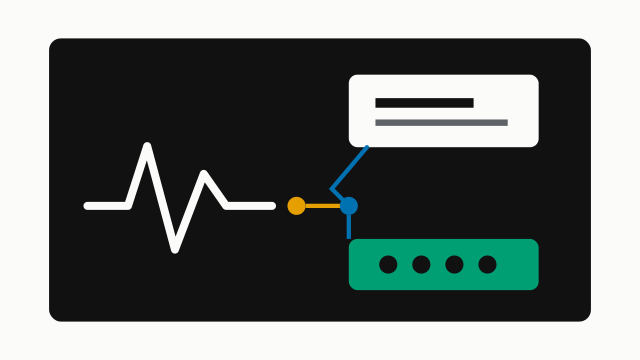
Health is similar. Instead of simply resting when tired, we check sleep scores, heart rate, exercise volume, and nutrition data. Communication is easier, but there are more unread messages and more channels awaiting a reply. Online services have removed visits to service counters, but they leave us managing accounts, passwords, two-factor authentication, consent settings, and notifications. Travel agencies have receded, and we now handle price comparisons, booking changes, and local routes ourselves. As consumer choice has expanded, so has the invisible work consumers perform.
This does not mean the past was better. Much of its simplicity came from having fewer choices or from risks remaining unseen. Illness still existed when it was measured less, and retirement risk still existed when it was not planned for. Housework, administration, and finding information also demanded far more physical labor. The question is not whether we should return to the past. It is why hard-won capabilities and saved time have not turned into room to breathe.
The Same Thing Happens With AI Tools
AI tools that perform several steps on a person's behalf can plan a trip, compare products, create presentations, ads, and videos, and fix software errors. Preparation takes less time, but the number of options to compare and facts to check grows. Making one result becomes choosing among several drafts, verifying facts, refining the expression, and storing the output. Creation is easier, but directing, judging, and taking responsibility do not disappear.
Fixing a small software error is just one example. If AI expands a narrow fix into changes to the surrounding structure and documentation, the result can look much faster at first. Yet there are more places to inspect, and solving new problems may make the whole system larger. This is not simply because AI is poor at the job. The cost of making things has fallen, while the cost of deciding what is right and remaining responsible for the result has not. The same pattern appears in documents, advertising, video, and data analysis. The ability to make more is not the same as the ability to make better decisions.
The Root Cause Lies Less in Technology Than in How We Use It
First, when capability expands, expectations rise with it. Once email became faster than post, replies came to be expected in hours rather than days. Once documents and media could be created quickly, producing more in the same time became the new standard. A private convenience becomes a social obligation when everyone has it.
Second, technology often moves complexity rather than removing it. Automation hides repetitive work inside a machine, but when an exception occurs, the user may have to connect several services and rules. A company gains efficiency while the user is left with settings, recovery procedures, and customer support. We should ask not only what was automated but also who becomes responsible when the automation ends.
Third, what can be measured starts to look like something that must be managed. Once sleep, steps, investment returns, focus time, and work performance become numbers, failing to improve them can look like neglect. Measurement helps us understand reality, but it can also keep us optimizing when things are already good enough. Life changes from something we experience into something we operate without end.
Fourth, choice can transfer responsibility for risk to the individual. When shared defaults such as stable pensions and care weaken while investment products, insurance plans, and health-management tools multiply, people gain freedom but must manage life's risks alone. Technology did not create every risk, but it widens the channel through which institutions and markets pass those risks to individuals.
Fifth, many products today make money from continued participation rather than completion. It is often better for business when users receive alerts, return, compare, and upgrade than when their problem ends and they leave. Technologies that keep demanding attention can grow faster than technologies that give attention back.
Beneath these five causes is a more fundamental point. We use technology more often as a means of growth than as a means of creating room to breathe. We do not preserve saved time and money as a pause; we spend them again on more production, choice, and improvement. Each individual task becomes more convenient while life as a whole becomes busier. Convenience is a property of one action. Ease is a property of the whole system.
Being Able to Do Something Does Not Mean We Must Do It Ourselves
Technology has opened work once reserved for specialists to almost everyone. We can invest, file taxes, design trips, repair our homes, search for health information, and draft promotional material and contracts ourselves. That access is real progress. But being able to begin is not the same as having the expertise to judge the result. Using a tool does not require us to carry final responsibility in every field alone.
Delegating to a specialist is not incompetence or waste. It is a way to place complexity where it belongs. If a task is rare, the cost of error is high, and learning it will not become an important capability in your life, handing it to an accountant, doctor, mechanic, lawyer, or financial professional may make life simpler overall. On the other hand, it is worth learning and doing work that recurs often and requires your own judgment. The point is to choose a boundary between doing everything yourself and surrendering every decision.
Good technology should not try to replace specialists unconditionally. It should help us find trustworthy people, explain our situation accurately, delegate only the necessary authority, understand the result and its cost, and withdraw that authority when we choose. AI can also reduce management burden when it handles research, drafts, and repetition while people retain important judgment and responsibility.
What Technology Needs in Order to Simplify Life
The aim of design must change. We should ask not only what users can do, but also what they no longer need to worry about. By that standard, good technology has the following qualities.
- It removes a task from beginning to end. It does not automate one step and leave the user with a monitoring screen and every exception.
- It makes a sensible choice for most people from the start. Important options remain open, but every user is not expected to become an expert.
- It supports safe delegation. A user can grant a specialist or family member only the authority they need, review the record, and revoke that authority at any time.
- It keeps the amount to manage small. Every new feature, account, alert, connected service, and setting carries a lifetime cost of care.
- It operates quietly. It asks for attention only when action is needed and does not confuse engagement time with success.
- It is understandable and reversible. It shows what happened and makes it inexpensive to return to an earlier state after failure.
- It designs the ending as well as the beginning. Cancellation, data transfer, replacement, and service shutdown should not damage the user's life.
- The party that creates complexity remains responsible for it. The user should not become the final troubleshooter among several systems.
The test is simple. After adopting this product, how many weekly decisions disappear? How many screens and alerts no longer need checking? Will there be less to maintain a year from now? Is it easy to recover or ask for help when something fails? Is it safe to forget about for a while? An easy interface is not enough. The technology must actually remove something from the user's life that required management.
Five Levels for Raising Productivity and Rest Together
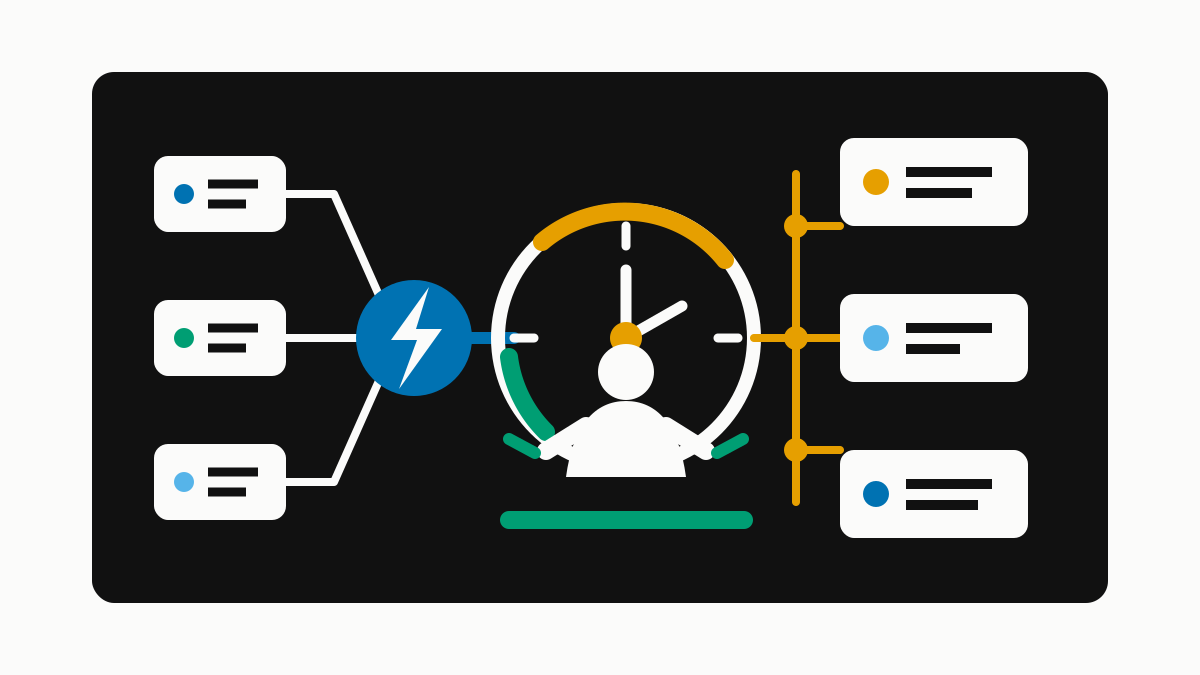
It is not enough to hope that greater productivity will eventually create leisure. Time and capacity without a named owner are quickly absorbed by new work. At several levels at once, we need rules that return part of the gains from productivity to people as breathing room.
The Individual Level
- Separate what you will do from what you will delegate. Give rare, high-consequence work to a trustworthy specialist, and use technology to find and work with that person.
- Define what is good enough and limit how many things you undertake at once. Stop when the purpose has been met, and end an existing project or subscription before adding another.
- Protect saved time first. If automation returns an hour, do not give all of it to new work; leave some for rest, relationships, and play that demand no measurable result.
The Team and Organization Level
- Make roles and decision owners clear. Do not involve everyone in everything; let the person with the relevant expertise decide while sharing the reasoning and responsibility.
- Limit work in progress and leave some time unfilled. Empty time is not waste but a buffer for problems, learning, and helping colleagues.
- Decide in advance how to use time saved by technology. Use some for better results and return some to the team through fewer meetings, less overtime, and schedules that allow recovery.
The Large Company Level
- Establish a rule that returns part of productivity gains to people. Do not spend all savings from technology on higher targets and head-count reduction; share them through shorter hours, leave, compensation, and retraining.
- When something new is created, retire something old. Every new product, process, and measure should come with a decision about what will end, who will maintain it, and when it will be closed.
- Measure what improved, not how busy everyone looked. Judge company performance by value delivered to customers, failures, maintenance burden, and time returned to employees rather than message counts and hours online.
The Social Level
- Expand the supply of specialists and services people can trust. Make qualifications, fees, whose interests are represented, and the limits of responsibility clear so that each person does not have to establish trust from scratch.
- Expand services and facilities people can share instead of requiring everyone to own and manage everything. Care, transport, libraries, tools, and shared space can reduce the burden of making every individual both buyer and manager.
- Stop treating fast replies and constant improvement as proof of diligence. Make room in social norms for communication that does not require an immediate answer, the right not to be contacted after work, rest, care, and civic participation.
The National Level
- Convert productivity growth into a dividend of time. Combine shorter working hours, adequate paid leave, and the right to disconnect with tax and procurement benefits for companies that share the gains from automation with workers.
- Redesign public services around the principle of submit once and receive by default. Do not ask repeatedly for information the state already has; notify or pay eligible people automatically while preserving expert help and a path to appeal.
- Put time and complexity on the national scorecard. Measure leisure time, care burden, administrative hours, health, and inequality alongside the size of the economy and output per hour to see what truly gives life back.
The principle is the same at every scale. Leave part of new capacity unused, make the creator of complexity carry its cost, and share productivity gains as people's time instead of converting all of them into higher expectations. Freedom is not only the ability to choose and do everything ourselves. It also includes the ability to entrust work to reliable people and institutions, and to leave some choices unmade.
The best technology may not be the technology that turns me into a more capable manager of everything. It helps me do what truly requires my hand, safely entrust what does not, and make unimportant work disappear altogether. What technology should return is not a few saved minutes, but a part of life we no longer have to think about.